15-Year vs. 30-Year Mortgage: Which Is Better? (2026 Guide)
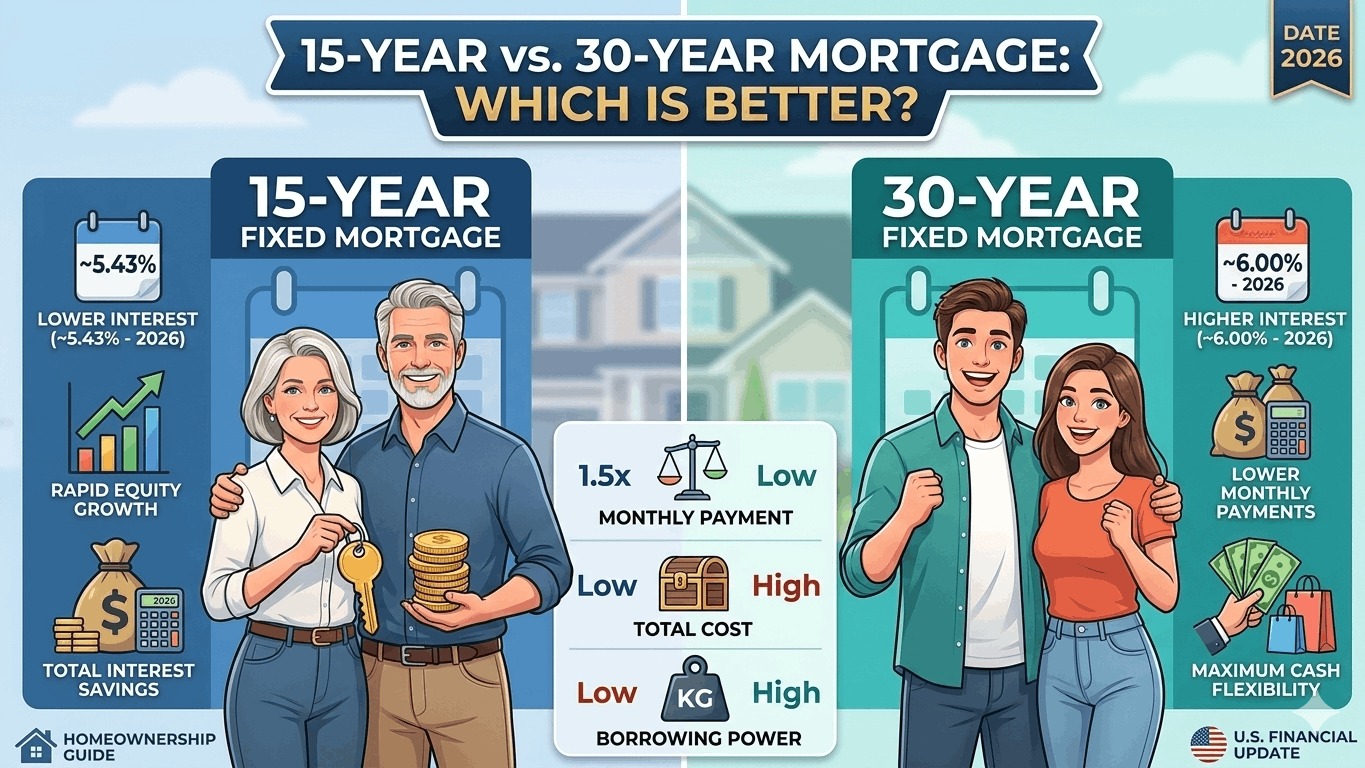
In the 2026 housing market, choosing between a 15-year and a 30-year mortgage is one of the most significant financial decisions you will make. With 30-year fixed rates currently hovering around 6.00% and 15-year rates significantly lower at roughly 5.43%, the "best" choice depends entirely on whether you prioritize monthly cash flow or long-term wealth building.
This comprehensive guide explores the math, the lifestyle implications, and the strategic "middle ground" for American homebuyers this year.
1. The Core Differences at a Glance
| Feature | 15-Year Fixed Mortgage | 30-Year Fixed Mortgage |
|---|---|---|
| Average Interest Rate (March 2026) | ~5.43% | ~6.00% |
| Monthly Payment | Significantly Higher (approx. 1.5x) | Lower and More Manageable |
| Total Interest Paid | Lowest | Highest |
| Equity Growth | Rapid | Slow (Initial years are interest-heavy) |
| Borrowing Power | Lower (due to higher DTI impact) | Higher (allows for a more expensive home) |
2. The Case for the 15-Year Mortgage
The 15-year mortgage is the "wealth-builder's" choice. Because you are compressed into a shorter repayment window, your money works harder for you from day one.
The "Interest Gap"
Lenders view 15-year loans as less risky because the debt is off their books in half the time. As of March 2026, you can typically secure a rate about 0.50% to 0.75% lower than a 30-year term.
Accelerated Equity
In a 30-year loan, the majority of your early payments go toward interest. In a 15-year loan, a much larger portion of your very first check goes toward the principal. This means if you need to sell or use a Home Equity Line of Credit (HELOC) in five years, you will have significantly more cash available.
Total Savings Example
Imagine a $400,000 loan:
- 30-Year @ 6.00%: You’ll pay roughly $463,000 in total interest over the life of the loan.
- 15-Year @ 5.43%: You’ll pay roughly $185,000 in total interest.
- The Result: Choosing the shorter term saves you over $278,000—the price of a second small home in some markets.
3. The Case for the 30-Year Mortgage
Despite the higher interest costs, the 30-year mortgage remains the most popular choice in the USA (accounting for nearly 90% of loans) for one reason: Flexibility.
Monthly Breathing Room
The 30-year term offers the lowest possible monthly payment. In a 2026 economy where inflation remains a concern, having an extra $800 to $1,200 in your pocket every month provides a safety net for emergencies, home repairs, or investing in the stock market.
Buying More House
Because mortgage lenders calculate your eligibility based on your Debt-to-Income (DTI) ratio, the lower payment of a 30-year loan allows you to qualify for a higher purchase price. If your dream home costs $500,000 but a 15-year payment on that amount exceeds 36% of your income, the 30-year loan may be your only path to that specific property.
4. The "Hybrid Strategy": The Best of Both Worlds
Many savvy 2026 buyers are opting for a 30-year mortgage but paying it like a 15-year.
Most U.S. mortgages do not have prepayment penalties. By taking the 30-year loan, you secure the flexibility of a lower required payment. However, if you have a high-income month or receive a bonus, you can apply extra principal payments.
- The Benefit: If you hit a financial rough patch (job loss or medical emergency), you can drop back to the lower 30-year payment without penalty.
- The Catch: You won't get the lower interest rate (5.43%) associated with the 15-year product, but you still save massively on interest by shortening the effective life of the loan.
5. Which One Is Right for You?
Choose a 15-Year Mortgage If:
- You are established in your career with a stable, high income.
- You are buying a "forever home" and want to be debt-free before retirement.
- You value "guaranteed" savings (interest avoidance) over the potential returns of the stock market.
Choose a 30-Year Mortgage If:
- You are a first-time buyer and need the lowest entry cost.
- You prefer to keep your cash "liquid" for other investments or business ventures.
- You are buying a "starter home" and plan to move or upgrade within 5 to 7 years.