I have said a hundred times
Motivational Quotes

I have said a hundred times Motivational Quotes at statush.com
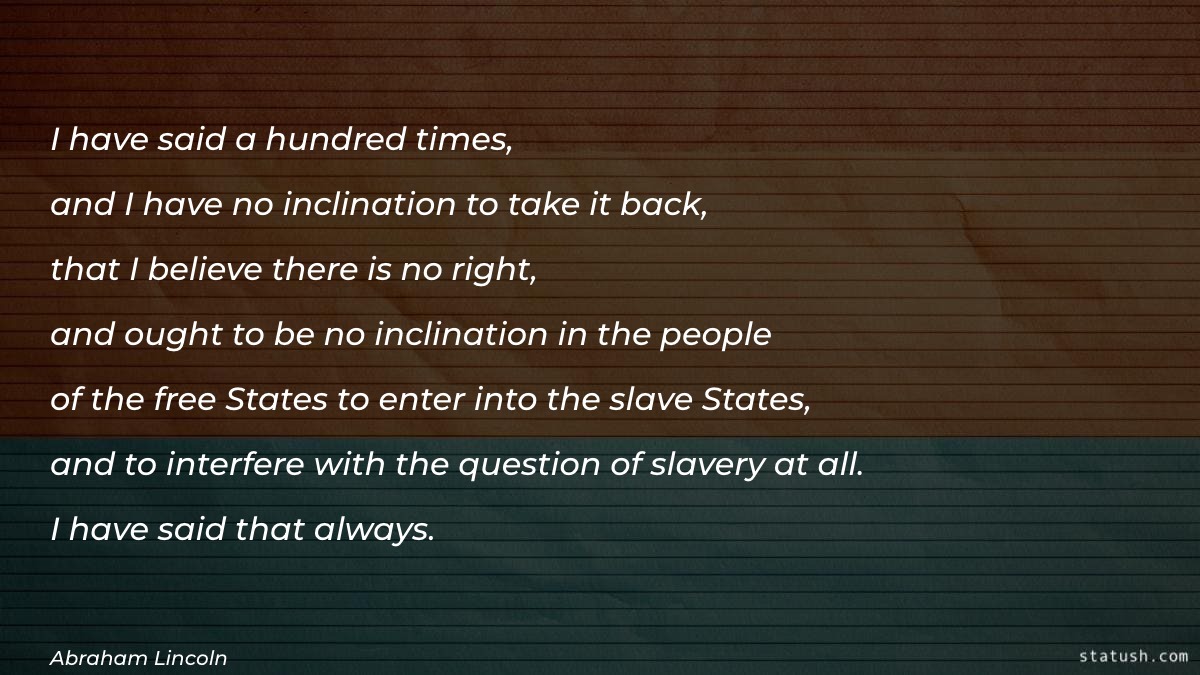
โ€œ I have said a hundred times, and I have no inclination to take it back, that I believe there is no right, and ought to be no inclination in the people of the free States to enter into the slave States, and to interfere with the question of slavery at all. I have said that always. โ€

Meaning

This quote means the speaker opposes outside interference with slavery where it already existed in the states. It reflects a repeated constitutional position rather than a moral approval.

About Author

Abraham Lincoln
Abraham Lincoln

Abraham Lincoln, the 16th President of the United States, is celebrated as one of Americaโ€™s greatest leaders. He guided the nation through the Civil War, preserved the Union, and abolished slavery with the Emancipation Proclamation. Known for his humility, wisdom, and unshakable principles, Lincolnโ€™s speeches and writings remain iconic for their eloquence and moral insight. His quotes often reflect perseverance, justice, empathy, and leadership in adversity. Lincolnโ€™s ability to unite a divided nation and his commitment to equality continue to inspire leaders, citizens, and thinkers worldwide. Beyond politics, his reflections on human nature, integrity, and courage offer timeless lessons on character and resilience. Lincolnโ€™s words serve as guidance for personal growth, moral decision-making, and the pursuit of justice, making him a source of inspiration for generations seeking wisdom and ethical leadership.

Related Quotes

โ€œ Labor is prior to, and independent of, capital. Capital is only the fruit of labor, and could never have existed if labor had not first existed. Labor is the superior of capital, and deserves much the higher consideration. โ€
This quote means labor is the original source of wealth, while capital comes afterward as its product. Human work deserves higher honor than accumulated money.
โ€œ My paramount object in this struggle is to save the Union, and is not either to save or to destroy slavery. If I could save the Union without freeing any slave, I would do it; and if I could save it by freeing some and leaving others alone, I would also do that. โ€
This quote means Lincoln\'s primary stated aim in that struggle was preserving the Union, with slavery policy treated in relation to that goal. It reflects a strategic rather than purely moral framing.
โ€œ I have great respect for the semicolon; it is a mighty handy little fellow. โ€
This quote is a playful expression of affection for punctuation and language. It finds charm in a small but useful detail.