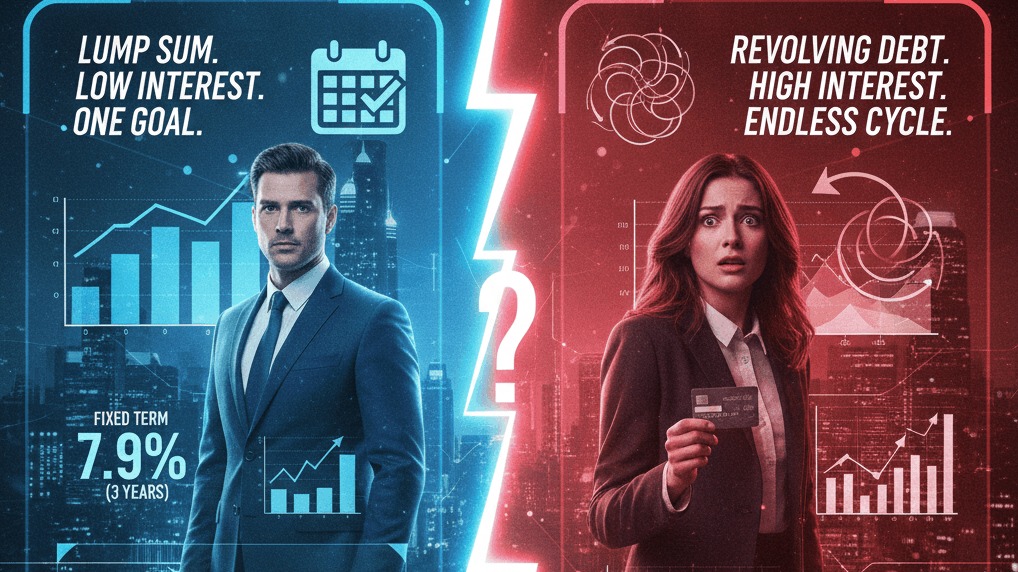
In 2026, Americans have more ways to borrow money than ever before. With credit card interest rates averaging over 23% and personal loan rates starting as low as 7% for top-tier borrowers, the choice you make can be the difference between a minor monthly bill and a years-long debt spiral.
But interest rates aren't the only factor. Depending on whether you're buying a $500 flight or a $20,000 home remodel, one of these tools is clearly superior.
Personal Loan vs. Credit Card: Which is Better in 2026?
- Meta Description: Compare personal loans vs. credit cards. Learn which is better for debt consolidation, home improvement, or daily spending in 2026.
- Keywords: personal loan vs credit card, credit card vs loan for debt, borrowing money 2026, interest rate comparison.
Excerpt
Should you swipe your card or take out a loan? In 2026, the answer depends on your "Financial Goal." We break down the costs, risks, and rewards of both options to help you choose the smartest path.
Quick Comparison Table (2026)
| Feature | Personal Loan | Credit Card |
|---|---|---|
| Average APR | 7% - 15% (Good Credit) | 21% - 28% |
| Repayment Term | Fixed (2 - 7 years) | Revolving (No end date) |
| Borrowing Limit | Lump Sum (Up to $100k) | Revolving Line (Up to $25k) |
| Collateral | Usually Unsecured | Unsecured |
| Best For | Large, one-time expenses | Smaller, ongoing purchases |
When to Choose a Personal Loan
A personal loan is an "installment loan." You get a lump sum of cash upfront and pay it back in equal monthly portions over a set period.
- Debt Consolidation: If you have $15,000 across three credit cards, a personal loan can combine them into one lower-interest payment.
- Major Life Events: Weddings, home renovations, or medical procedures.
- Predictability: You know exactly when you will be debt-free (e.g., "I'll be done in 36 months").
Pros: Lower interest rates; fixed monthly payments; helps your "credit mix."
Cons: Harder to qualify for; may have an "origination fee" (1% - 6%); less flexible once the money is spent.
When to Choose a Credit Card
A credit card is "revolving credit." You have a limit, you spend what you need, and you can borrow again as you pay it back.
- Daily Expenses: Groceries, gas, and subscriptions (to earn cash back).
- Short-Term Needs: If you can pay the full balance within 30 days, you pay 0 interest.
- 0% APR Offers: If you qualify for a card with an introductory 0% rate for 15-21 months, this is the cheapest way to borrow.
Pros: Instant access to funds; rewards (points/miles); no interest if paid in full monthly.
Cons: Extremely high interest if you carry a balance; easy to overspend; variable rates can rise.
Which is Better for You?
Scenario A: You owe $10,000 and want to pay it off over 3 years.
- Credit Card: At 24% APR, your monthly payment would be about $392, and you'd pay $4,112 in total interest.
- Personal Loan: At 10% APR, your monthly payment would be about $322, and you'd pay only $1,616 in total interest.
- Winner: Personal Loan (Saves you nearly $2,500).
Scenario B: You need $800 for a new laptop and can pay it off in 4 months.
- Credit Card: If you have a card with a 0% intro offer, you pay $0 in interest.
- Personal Loan: You may not be able to find a loan for such a small amount, and you'd likely pay an origination fee.
- Winner: Credit Card.
Tips for Both Options
- Check Your Credit First: Both lenders will pull your credit. Ensure your score is above 670 for the best rates in 2026.
- Read the Fine Print: Look for "Prepayment Penalties" on loans and "Annual Fees" on cards.
- Use Autopay: Regardless of the tool, one late payment can tank your score by 60+ points.