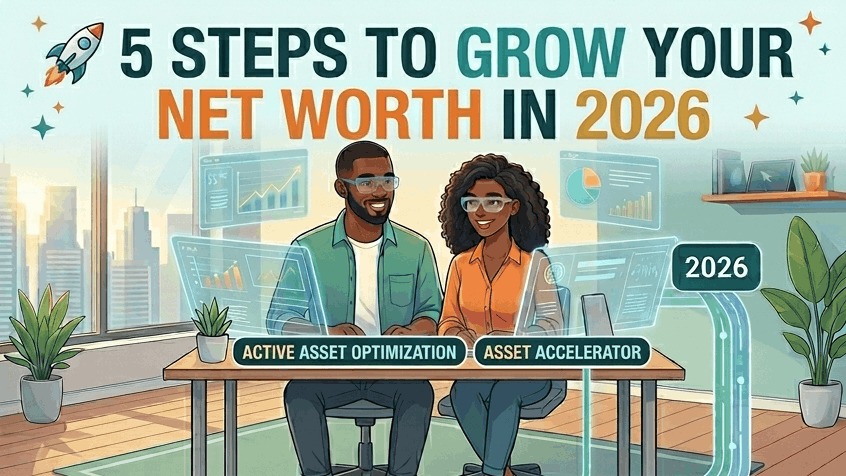
In 2026, growing your net worth is no longer just about "saving more than you spend." It is about Active Asset Optimization. With the global economy shifting toward AI-driven productivity and decentralized finance, your net worth is a reflection of how effectively you orchestrate your capital, your skills, and your tools.
This guide provides the definitive 2026 framework for moving from a "linear income" to "exponential net worth growth."
1. The Net Worth Formula: Beyond the Spreadsheet
Your net worth is the sum of everything you own (assets) minus everything you owe (liabilities). In 2026, the goal is to shift your focus from "high income" to “high equity.”
- Assets: Cash, HYSAs, Stocks/Index Funds, Real Estate, Business Equity, and Intellectual Property.
- Liabilities: Mortgages, Student Loans, Car Loans, and Credit Card Debt.
Net Worth = (Total Assets) - (Total Liabilities)
2. Phase 1: Expansion of the "Investment Gap"
To grow your net worth, you must widen the gap between what you earn and what you consume. This is the "Investment Gap."
Increasing the Inflow (Earning)
In 2026, the fastest way to increase inflow is through Skill Stacking. Combining your primary profession with AI-orchestration skills allows you to command a premium.
- The 2026 Rule: Use AI agents to handle low-value tasks, freeing you to focus on high-ticket advisory or creative strategy.
Controlling the Outflow (Spending)
- The "Anti-Budget": Instead of tracking every latte, automate your investments to leave your account the day you get paid. You live on whatever is left. This ensures your net worth grows before you have the chance to spend.
- Lifestyle Inflation Hedge: When you get a raise or a bonus in 2026, commit at least 70% of that increase directly to your brokerage or retirement accounts.
3. Phase 2: Asset Acceleration
Once you have capital, you must put it into vehicles that grow faster than inflation.
The 2026 "Core and Satellite" Portfolio
- The Core (80%): Low-cost, broad-market Index Funds (e.g., S&P 500 or Nifty 50). This provides the "Beta" or the steady market growth.
- The Satellite (20%): High-growth sectors. In 2026, this includes Agentic AI ETFs, Green Energy Infrastructure, and Emerging Market Tech.
Strategic Debt Paydown
Not all debt is equal.
- Bad Debt (7%+): Credit cards and high-interest personal loans. These are "negative investments" that destroy your net worth. Eliminate these first.
- Good Debt (<4%): Low-interest mortgages or business loans. In 2026, if your debt costs less than what the market returns, it may be more profitable to invest rather than pay it off early.
4. Phase 3: Tax and Fee Optimization
You don't grow your net worth by what you make; you grow it by what you keep.
- Tax-Loss Harvesting: Use AI-driven brokerage tools to automatically sell "losing" stocks to offset the gains from your "winners," reducing your tax bill.
- Maximizing Tax-Advantaged Buckets: * USA: Maximize the 401(k) match, Roth IRA, and HSA.
- India: Prioritize ELSS for equity exposure with tax benefits and PPF for risk-free, tax-exempt compounding.