One of the biggest surprises many investors face is realizing that investment profits are not all taxed the same way.
You might buy two different investments, make the exact same amount of money on both, and still owe completely different amounts in taxes depending on how long you held them.
That difference comes down to capital gains taxes.
Understanding long-term vs short-term capital gains is extremely important because taxes can significantly affect your actual investment returns over time.
And honestly, many beginners focus heavily on making profits while barely thinking about what happens after taxes. But smart investors know that keeping more of your gains matters just as much as generating them.
What Are Capital Gains?
A capital gain happens when you sell an investment for more than you originally paid.
For example:
- You buy a stock for $1,000
- Later sell it for $1,500
- Your capital gain equals $500
Capital Gain = Selling Price - Purchase Price
Capital gains can apply to many types of investments, including:
- Stocks
- Bonds
- ETFs
- Mutual funds
- Real estate
- Cryptocurrency
- Collectibles
The tax treatment depends largely on how long you held the investment before selling it.
What Are Short-Term Capital Gains?
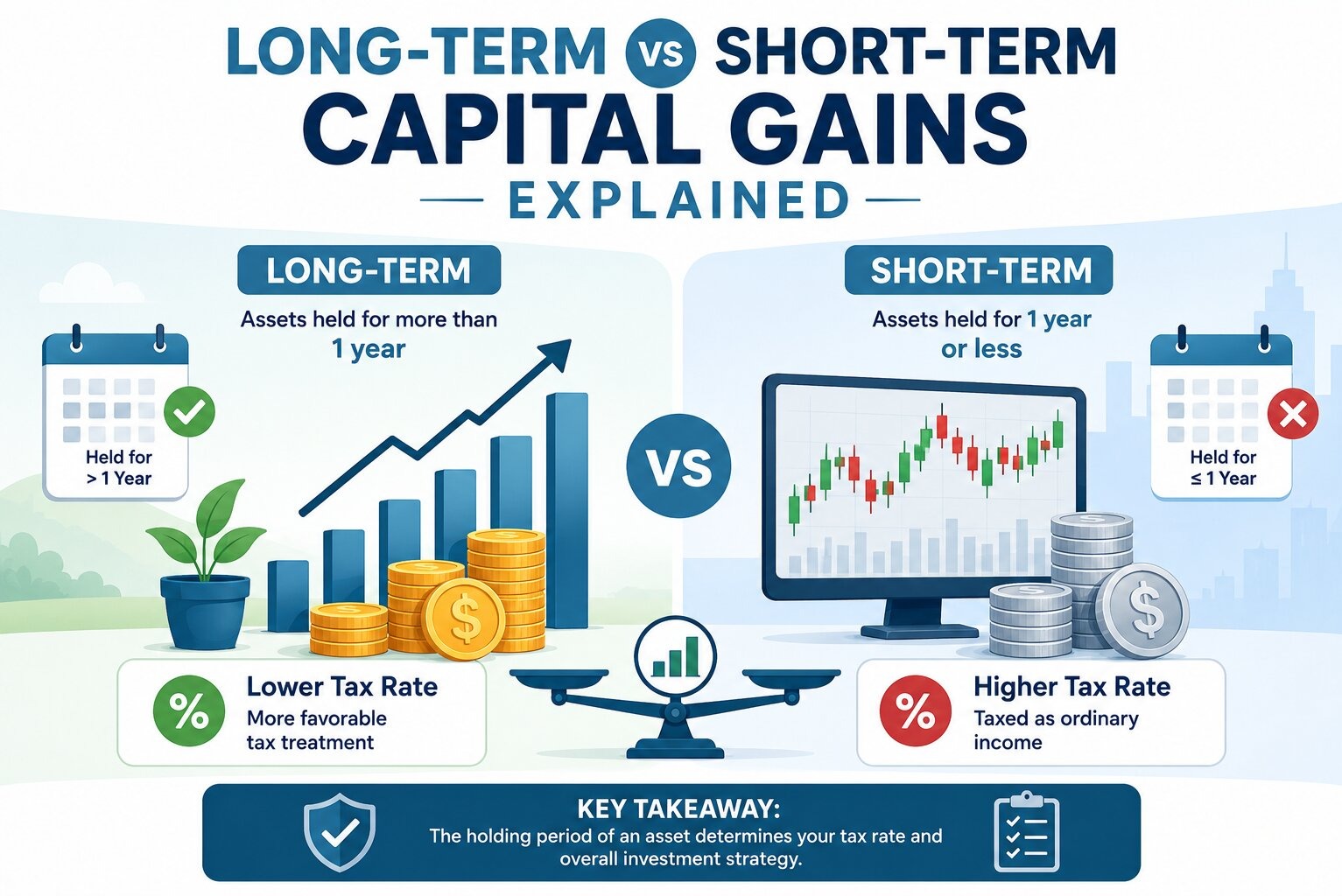
Short-term capital gains apply when you sell an investment held for one year or less.
These gains are typically taxed at ordinary income tax rates.
That means short-term gains are often taxed at higher rates than long-term gains.
Example of a Short-Term Capital Gain
Suppose:
- You buy shares in January
- Sell them in August
- Earn a $2,000 profit
Because the investment was held for less than one year, the profit generally qualifies as a short-term capital gain.
The tax rate applied depends on your regular income tax bracket.
What Are Long-Term Capital Gains?
Long-term capital gains apply when investments are held for more than one year before being sold.
These gains usually receive more favorable tax treatment.
Governments often encourage long-term investing by taxing long-term gains at lower rates compared to short-term trading profits.
Example of a Long-Term Capital Gain
Suppose:
- You buy a stock in January 2024
- Sell it in March 2025
- Earn a $2,000 profit
Because you held the investment for more than one year, the gain generally qualifies as long-term.
In many countries, this results in lower tax rates.
Why Governments Tax Them Differently
The idea behind lower long-term capital gains taxes is fairly straightforward.
Long-term investing tends to:
- Encourage business investment
- Promote market stability
- Reduce excessive speculation
- Support economic growth
Short-term trading, on the other hand, is often viewed as more speculative.
As a result, governments frequently reward patience with lower tax rates.
Simple Comparison Table
| Feature | Short-Term Capital Gains | Long-Term Capital Gains |
|---|---|---|
| Holding Period | 1 year or less | More than 1 year |
| Tax Treatment | Ordinary income rates | Lower preferential rates |
| Investor Style | Frequent trading | Long-term investing |
| Tax Efficiency | Usually lower | Usually higher |
This difference can dramatically affect long-term wealth building.
Why Taxes Matter More Than Many Investors Realize
Imagine two investors who both earn 10% annual returns.
Investor A
- Trades frequently
- Pays higher short-term taxes repeatedly
Investor B
- Holds investments long term
- Benefits from lower long-term tax rates
Over many years, Investor B may keep significantly more wealth simply because of better tax efficiency.
That compounding difference becomes surprisingly large over decades.
The Hidden Cost of Frequent Trading
Frequent trading can create several problems:
- Higher taxes
- More transaction costs
- Increased emotional decisions
- Greater timing mistakes
Many beginner investors underestimate how much taxes reduce active trading profits.
Sometimes investors make strong gains but lose a meaningful portion to taxes because they traded too aggressively.
This is one reason passive investing became so popular.
You can explore this idea more deeply in Passive vs Active Investing Strategies.
Capital Losses Can Offset Gains
Not every investment produces profits.
If you sell investments at a loss, those losses may help reduce taxable gains.
For example:
- Stock A gain = $5,000
- Stock B loss = $2,000
Your net taxable gain may become:
Net\ Capital\ Gain = 5000 - 2000 = 3000
This strategy is often called tax-loss harvesting.
Some investors intentionally sell losing positions near year-end to offset gains elsewhere in their portfolios.
Long-Term Investing Often Improves Tax Efficiency
Long-term investors benefit in several ways:
- Lower taxes
- Reduced trading costs
- Less emotional stress
- More compounding potential
That doesn’t mean investors should never sell.
Sometimes selling makes sense due to:
- Changing financial goals
- Poor company fundamentals
- Portfolio rebalancing
- Risk management
But avoiding unnecessary short-term trading can improve overall returns significantly.
Real-World Example
Imagine two investors each starting with $100,000.
Investor A
- Trades constantly
- Generates short-term taxable gains every year
- Pays higher taxes repeatedly
Investor B
- Holds investments for many years
- Defers taxes longer
- Receives lower long-term capital gains rates
Even if both achieve similar market returns, Investor B may end up substantially wealthier because less money is lost to taxes annually.
That’s one reason many wealthy investors prioritize tax efficiency heavily.
Capital Gains and Retirement Accounts
Some investment accounts offer tax advantages that change how capital gains work.
Depending on the country and account type:
- Taxes may be deferred
- Gains may grow tax-free
- Withdrawals may receive special treatment
These accounts can significantly improve long-term compounding.
Tax-efficient investing strategies often combine:
- Long holding periods
- Diversification
- Strategic account placement
You can explore broader strategies in Tax-Efficient Investing Strategies.
Common Beginner Mistakes
Selling Too Quickly
Many investors sell winning investments too early without considering tax consequences.
Waiting slightly longer may qualify gains for lower long-term tax treatment.
Ignoring Tax Planning Entirely
Some investors focus only on returns while completely overlooking after-tax performance.
But after-tax returns are what actually matter financially.
Overtrading
Frequent buying and selling often:
- Increases taxes
- Raises costs
- Encourages emotional behavior
Holding Bad Investments Only for Tax Reasons
Tax savings alone should not justify holding weak investments indefinitely.
Investment quality still matters most.
Long-Term Investing and Compounding
Long-term investing offers another major advantage beyond lower taxes: compounding.
When profits remain invested longer:
- Gains generate additional gains
- Dividends compound
- Taxes stay deferred longer
This combination can accelerate wealth growth significantly over time.
This idea aligns closely with strategies discussed in How to Create a Passive Investment Portfolio.
Practical Tips for Investors
Think About After-Tax Returns
A lower-tax investment strategy may outperform a higher-return strategy after taxes are considered.
Avoid Emotional Short-Term Trading
Constant trading often creates unnecessary tax bills.
Keep Good Records
Track:
- Purchase dates
- Cost basis
- Sale prices
- Dividends
Good records simplify tax reporting later.
Understand Local Tax Rules
Capital gains tax rules vary by country and sometimes change over time.
Always verify current regulations relevant to your situation.
Long-Term vs Short-Term Investing Mindset
There’s also a psychological difference between short-term and long-term investing.
Short-term trading often focuses on:
- Market timing
- Momentum
- News headlines
- Fast profits
Long-term investing focuses more on:
- Business quality
- Compounding
- Patience
- Sustainable growth
Historically, long-term disciplined investing has often produced more stable outcomes for ordinary investors.
Final Thoughts
The difference between long-term and short-term capital gains may seem like a technical tax topic at first, but it has a major impact on real-world investment results.
Short-term gains usually face higher taxes, while long-term investing often benefits from lower tax rates, better compounding, and reduced emotional decision-making.
That’s why experienced investors frequently focus not just on earning returns, but on keeping as much of those returns as possible after taxes.
And honestly, once investors begin thinking in after-tax terms instead of just headline profits, they often start making much smarter long-term financial decisions overall.