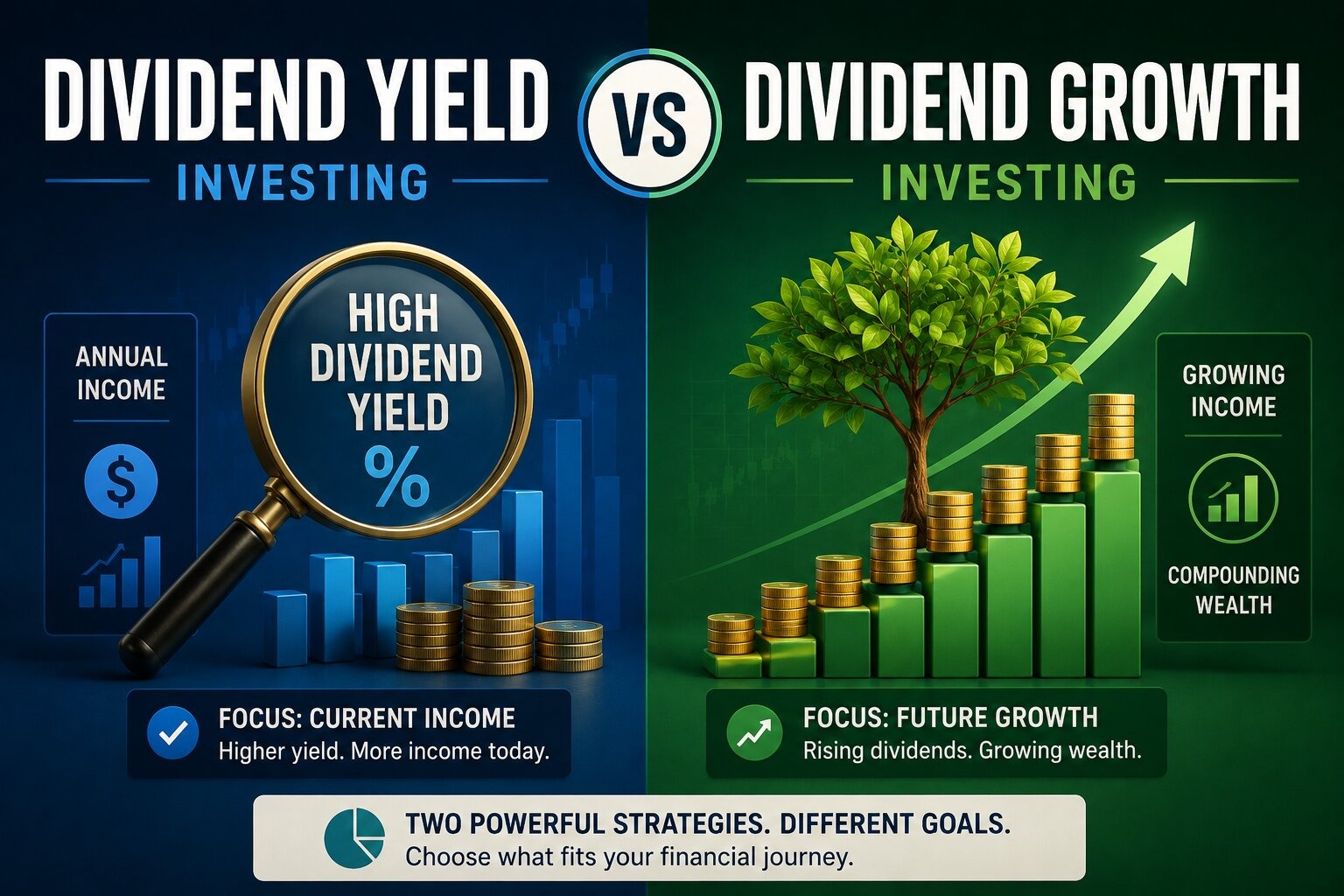
Dividend investing is not just one strategy. In reality, there are multiple ways investors approach dividend stocks, and two of the most common methods are dividend yield investing and dividend growth investing.
At first, these strategies can sound very similar because both focus on dividend-paying companies. But once you look closer, the goals and investing styles become quite different.
Some investors prioritize immediate income through high-yield stocks. Others focus on companies that steadily increase dividends year after year, even if the starting yield looks smaller.
Neither strategy is automatically better. It mostly depends on your financial goals, risk tolerance, and long-term investing priorities.
Understanding the difference can help you build a dividend portfolio that actually matches your needs instead of simply chasing the highest numbers you see online.
What Is Dividend Yield Investing?
Dividend yield investing focuses primarily on stocks that already pay relatively high dividend yields.
Dividend yield measures how much annual income a stock pays relative to its share price.
\text{Dividend Yield} = \frac{\text{Annual Dividend Per Share}}{\text{Stock Price}} \times 100
For example:
| Stock Price | Annual Dividend | Dividend Yield |
|---|---|---|
| $100 | $5 | 5% |
| $50 | $3 | 6% |
Investors using this strategy often prioritize:
- Immediate passive income
- Higher cash flow
- Income-focused portfolios
- Retirement income generation
High-yield investing is especially popular among retirees or investors seeking regular income streams.
If you are new to dividend investing overall, you may also want to read How to Start Dividend Investing.
Advantages of Dividend Yield Investing
Higher Immediate Income
The biggest attraction is obvious: higher current income.
For example:
- A 7% dividend yield generates more immediate cash flow than a 2% yield
- Investors may rely on dividends for living expenses
This approach can be appealing for:
- Retirees
- Passive income investors
- Income-focused portfolios
Potential Stability
Many high-yield companies operate in mature industries such as:
- Utilities
- Telecommunications
- Energy
- Real estate investment trusts (REITs)
These businesses often generate relatively predictable cash flow.
Easier Income Forecasting
Investors focused on current income may find budgeting easier because dividends create recurring cash payments.
Some investors specifically aim to build portfolios that cover monthly expenses entirely through dividends.
Honestly, that financial independence angle is what attracts many people to dividend investing in the first place.
Risks of High Dividend Yield Investing
High yield is not always a good sign.
This is one of the biggest mistakes beginners make.
Dividend Traps
Sometimes a stock’s yield becomes extremely high because the stock price has fallen sharply.
For example:
- Company faces financial problems
- Stock price drops
- Dividend yield rises artificially
At first glance, the yield may look attractive. But the dividend itself may not be sustainable.
This is often called a dividend trap.
Slower Business Growth
Some high-yield companies are mature businesses with slower growth potential.
That can limit long-term capital appreciation compared to faster-growing companies.
Dividend Cuts
Companies can reduce or eliminate dividends during difficult financial periods.
This risk becomes especially important when companies pay unsustainably high portions of earnings as dividends.
You can learn more about evaluating company quality in How to Analyze Stocks Before Investing.
What Is Dividend Growth Investing?
Dividend growth investing focuses on companies that consistently increase dividends over time.
Instead of chasing the highest current yield, investors prioritize:
- Dividend growth history
- Earnings growth
- Financial strength
- Long-term compounding
These companies may initially offer lower yields, but dividend income can grow significantly over time.
Example of Dividend Growth
| Year | Annual Dividend |
|---|---|
| Year 1 | $1.00 |
| Year 5 | $1.80 |
| Year 10 | $3.20 |
Over long periods, rising dividends can substantially increase total income.
This strategy often appeals to younger investors focused on long-term wealth building.
Advantages of Dividend Growth Investing
Stronger Companies
Companies that consistently raise dividends usually have:
- Stable earnings
- Strong cash flow
- Disciplined management
- Competitive advantages
Consistent dividend growth often reflects financial health.
Better Long-Term Compounding
Dividend growth investing can create powerful compounding effects over decades.
For example:
- Dividends increase annually
- Reinvested dividends buy more shares
- Growing shares produce even more income
Over time, income growth can become surprisingly large.
You may also enjoy reading Best Dividend Reinvestment Strategies.
Inflation Protection
Rising dividends can help offset inflation.
If dividend income grows consistently:
- Purchasing power improves
- Income keeps pace with rising living costs
This can become especially valuable during long retirement periods.
You can learn more in How Inflation Impacts Stock Market Investments.
Risks of Dividend Growth Investing
Dividend growth investing also has limitations.
Lower Starting Yield
Many dividend growth companies begin with modest yields.
For example:
- 1%
- 2%
- 3%
Investors seeking immediate income may find this disappointing initially.
Growth Can Slow
Even strong companies may eventually slow dividend increases.
Industries change, competition increases, and economic conditions shift over time.
Higher Valuations
Popular dividend growth companies often trade at premium prices because investors value their stability.
That can reduce future returns if stocks become overpriced.
Dividend Yield vs Dividend Growth: Side-by-Side Comparison
| Feature | Dividend Yield Investing | Dividend Growth Investing |
|---|---|---|
| Main Goal | Immediate income | Long-term income growth |
| Starting Yield | Higher | Lower |
| Growth Potential | Moderate | Often stronger |
| Risk of Dividend Cuts | Sometimes higher | Usually lower |
| Best For | Retirees, income investors | Younger long-term investors |
| Focus | Cash flow today | Growing income tomorrow |
Which Strategy Is Better?
Honestly, there is no universal winner.
It depends entirely on the investor.
Dividend Yield Investing May Be Better If:
- You need income now
- You prioritize cash flow
- You are near retirement
- You prefer mature businesses
Dividend Growth Investing May Be Better If:
- You have a long investment timeline
- You want rising future income
- You prioritize business quality
- You want stronger compounding potential
Many experienced investors actually combine both approaches.
For example:
- High-yield stocks for current income
- Dividend growth stocks for future growth
That balance can create both stability and long-term expansion.
The Importance of Diversification
Dividend investors sometimes make the mistake of concentrating too heavily in a few industries.
Common dividend-heavy sectors include:
- Utilities
- Financials
- Energy
- Consumer staples
Without diversification, portfolios can become vulnerable to sector-specific problems.
This is why balanced investing remains important.
You can read more in Portfolio Diversification Strategies.
Dividend ETFs for Beginners
Beginners who do not want to research individual stocks may prefer dividend ETFs.
These funds provide:
- Diversification
- Simplicity
- Lower company-specific risk
- Exposure to many dividend-paying businesses
Some ETFs focus on:
- High dividend yield
- Dividend growth
- Dividend aristocrats
If you are still learning investment basics, check out Index Fund vs ETF: Key Differences Explained.
Long-Term Thinking Matters Most
One important reality about dividend investing is that patience matters enormously.
Successful dividend portfolios are usually built gradually over many years.
Investors who consistently:
- Reinvest dividends
- Stay diversified
- Avoid emotional decisions
- Focus on quality businesses
often experience the strongest long-term results.
This is why long-term strategy matters more than chasing short-term trends.
You may also enjoy reading How to Build a Long-Term Investment Strategy.
Final Thoughts
Dividend yield investing and dividend growth investing are both valid long-term strategies, but they serve different purposes.
High-yield investing prioritizes current income, while dividend growth investing focuses more on future income expansion and long-term compounding.
The best approach depends on:
- Your financial goals
- Your timeline
- Your income needs
- Your risk tolerance
In many cases, combining both strategies can create a balanced portfolio with income today and growing income tomorrow.
At the end of the day, successful dividend investing is usually less about chasing the highest yield and more about owning strong businesses that can continue rewarding shareholders for many years.