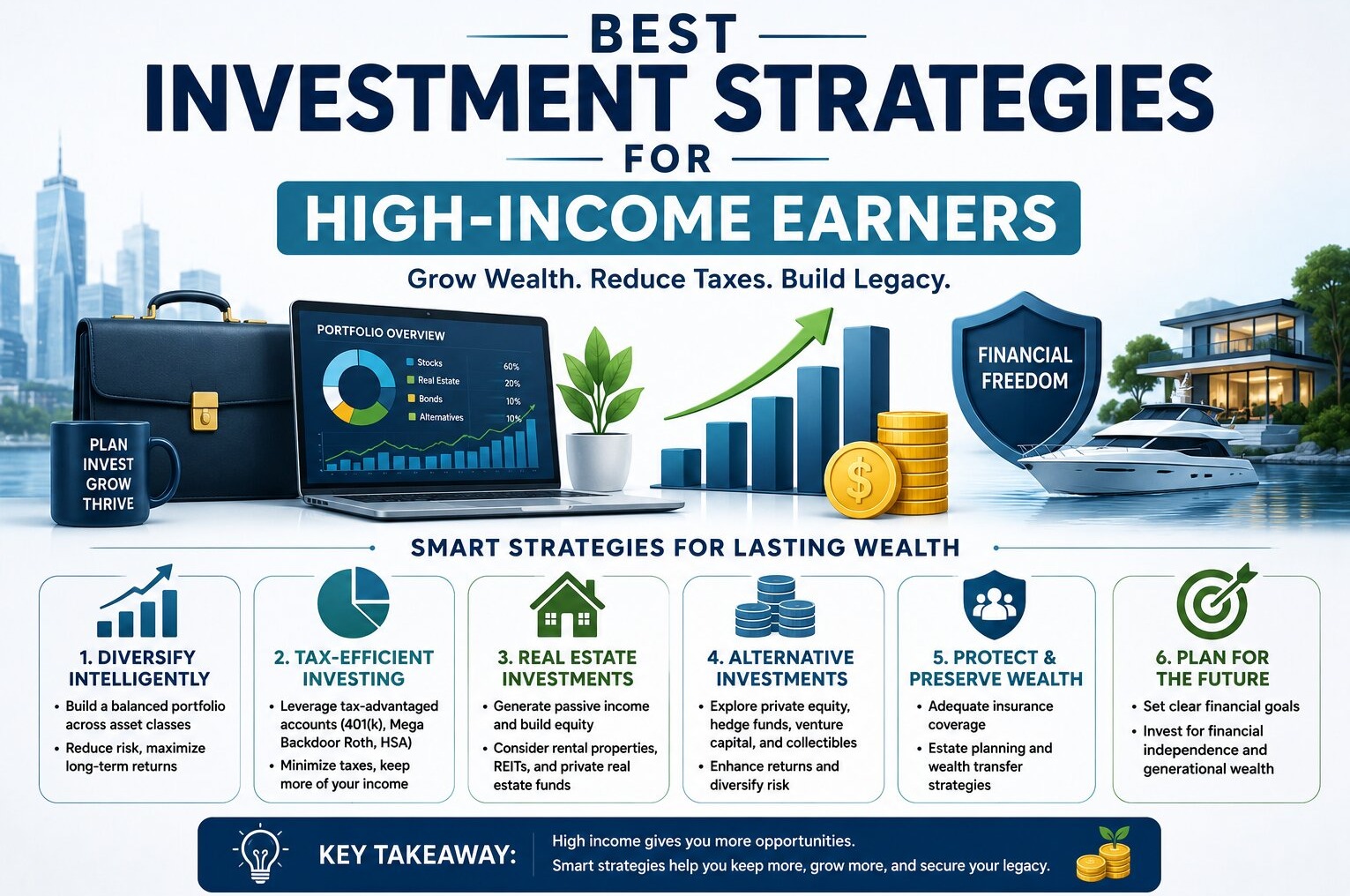
Earning a high income creates opportunities that many people work years to achieve. But surprisingly, a high salary alone does not automatically lead to wealth.
In fact, many high-income earners still struggle financially because lifestyle inflation quietly consumes most of their earnings. Bigger salaries often lead to bigger homes, more expensive cars, luxury spending, and rising monthly obligations.
That’s why investing becomes especially important for high-income earners.
A strong income gives you powerful advantages:
- More capital to invest
- Greater flexibility
- Faster wealth-building potential
- Ability to recover from mistakes more easily
But it also creates unique challenges like higher taxes, concentration risk, and pressure to maintain expensive lifestyles.
The best investment strategies for high-income earners focus not only on growing wealth, but also on protecting it efficiently over time.
Why High-Income Earners Need a Strategy
Many professionals assume earning more automatically solves financial problems.
Not necessarily.
Without a clear investment plan, even high earners can face:
- Poor tax efficiency
- Overconcentration in employer stock
- Emotional investing
- Excessive spending
- Delayed retirement savings
The good news is that disciplined investing becomes much easier when cash flow is strong.
Consistency matters far more than chasing perfect investments.
Maximize Tax-Advantaged Accounts
One of the smartest first steps for high-income earners is fully utilizing tax-advantaged investment accounts whenever possible.
These accounts may offer:
- Tax-deferred growth
- Tax-free withdrawals
- Lower taxable income
- Better long-term compounding
Because high earners usually fall into higher tax brackets, the tax savings can become especially valuable.
Why This Matters
Every dollar legally protected from unnecessary taxes stays invested longer and compounds more efficiently.
Over decades, that difference becomes enormous.
This connects closely with strategies discussed in Tax-Efficient Investing Strategies.
Focus on Long-Term Investing
High-income earners sometimes feel pressure to “beat the market” because they have more capital available.
But frequent trading often creates:
- Higher taxes
- Emotional decision-making
- Greater stress
- Increased risk
Long-term investing remains one of the most effective wealth-building approaches.
Historically, patient investors focusing on quality assets and consistent contributions have often outperformed overly aggressive traders.
Build a Diversified Portfolio
A diversified portfolio reduces dependence on any single investment.
This is especially important for high earners who may already have concentrated exposure through:
- Employer stock
- Industry-specific income
- Business ownership
Diversification May Include
| Asset Type | Purpose |
|---|---|
| Stocks | Long-term growth |
| Bonds | Stability and income |
| Real estate | Diversification |
| Cash reserves | Liquidity |
| International investments | Geographic exposure |
Diversification helps reduce catastrophic risk while maintaining growth potential.
You can explore broader risk management ideas in How to Reduce Investment Risk.
Avoid Lifestyle Inflation
This may not sound like investing advice, but it’s one of the biggest factors separating wealthy high earners from financially stressed high earners.
Lifestyle inflation happens when spending rises as income increases.
Examples include:
- Constantly upgrading homes
- Luxury vehicles
- Expensive subscriptions
- Overspending on status purchases
The problem is not enjoying success. The problem is allowing fixed expenses to grow faster than investments.
Many financially independent people simply maintained reasonable lifestyles while investing aggressively.
Invest Consistently, Not Emotionally
High-income earners often have volatile schedules and demanding careers.
That makes automation extremely valuable.
Automatic investing removes:
- Timing stress
- Emotional decisions
- Procrastination
Consistent monthly investing often matters more than perfectly timing markets.
Use Index Funds and ETFs
Many successful high-income earners prefer low-cost index investing because:
- Fees stay low
- Diversification improves
- Taxes may be reduced
- Management becomes simpler
Trying to constantly outperform the market can become time-consuming and emotionally exhausting.
For busy professionals, simplicity often wins.
This aligns closely with concepts discussed in Passive vs Active Investing Strategies.
Understand Tax Efficiency
High earners are more exposed to taxes simply because of higher income brackets.
This makes tax efficiency especially important.
Common Tax-Efficient Strategies
- Holding investments long term
- Minimizing unnecessary trading
- Strategic asset placement
- Tax-loss harvesting
- Using retirement accounts effectively
Even modest tax improvements can save substantial amounts annually at higher income levels.
Don’t Ignore Emergency Savings
Some high earners underestimate the importance of cash reserves because income feels stable.
But high salaries often come with:
- Industry concentration
- Career pressure
- Economic sensitivity
An emergency fund provides flexibility during:
- Job changes
- Market downturns
- Health issues
- Economic uncertainty
Financial security matters just as much as investment growth.
Consider Real Estate Carefully
Many high-income earners eventually explore real estate investing.
Potential advantages include:
- Rental income
- Diversification
- Inflation protection
- Leverage opportunities
However, real estate also involves:
- Maintenance
- Illiquidity
- Market risk
- Management responsibilities
Real estate can work well within a balanced portfolio, but it should not automatically dominate investment planning.
Avoid Overconfidence
One surprising risk for high earners is overconfidence.
Professional success in one field does not automatically translate into investing expertise.
Some common mistakes include:
- Excessive speculation
- Overtrading
- Concentrated bets
- Chasing market hype
Strong incomes can temporarily hide poor investing behavior because mistakes feel less painful initially.
But large financial errors still compound over time.
Employer Stock Risk
Many executives and professionals receive:
- Stock options
- Restricted stock units
- Equity compensation
While this can create tremendous wealth, excessive concentration in employer stock becomes risky.
Imagine:
- Your job depends on one company
- Most investments also depend on that same company
If the business struggles, both income and investments may decline simultaneously.
Diversification becomes extremely important here.
Invest According to Time Horizon
A 30-year-old professional and a 60-year-old executive may require completely different investment approaches.
Younger High Earners
Often prioritize:
- Aggressive growth
- Higher stock allocation
- Long-term compounding
Older High Earners
May focus more on:
- Wealth preservation
- Income generation
- Lower volatility
- Retirement planning
This connects naturally with ideas discussed in Investment Portfolio Allocation by Age.
Real-World Example
Imagine two doctors earning similar high incomes.
Doctor A
- Spends aggressively
- Trades speculative investments constantly
- Carries large debt
- Saves inconsistently
Doctor B
- Invests automatically
- Diversifies broadly
- Controls lifestyle inflation
- Focuses on long-term growth
After 20 years, Doctor B may have dramatically greater net worth despite earning similar salaries.
Income creates opportunity. Investing discipline determines long-term results.
Common Mistakes High-Income Earners Make
| Mistake | Risk |
|---|---|
| Lifestyle inflation | Slower wealth growth |
| Excessive speculation | Large losses |
| Poor tax planning | Reduced after-tax returns |
| Concentrated stock positions | Higher portfolio risk |
| Delayed investing | Lost compounding time |
Practical Investment Tips
Automate Investments
Consistency removes emotional decision-making.
Increase Savings With Income Growth
As income rises, increase investments instead of only increasing spending.
Prioritize Financial Flexibility
Wealth provides options and freedom, not just luxury purchases.
Think Beyond Income
High income matters, but net worth and cash flow stability matter more long term.
Final Thoughts
High-income earners possess one of the most powerful tools in investing: strong earning capacity.
But turning income into lasting wealth requires intentional strategy, discipline, and patience.
The most effective investment strategies for high earners usually focus on:
- Long-term investing
- Tax efficiency
- Diversification
- Controlled lifestyle inflation
- Consistent investing habits
And honestly, many wealthy investors are not necessarily the people earning the absolute highest salaries. Often, they are simply the people who consistently invested well, managed risk wisely, and avoided letting lifestyle growth consume their financial future.