Inflation is one of the most important forces in personal finance and investing, yet many beginners do not fully understand how deeply it affects their money. People often notice inflation first at the grocery store, gas station, or when paying rent, but its influence goes far beyond everyday prices. Inflation also changes how investments perform, how portfolios are built, and how investors think about long-term wealth.
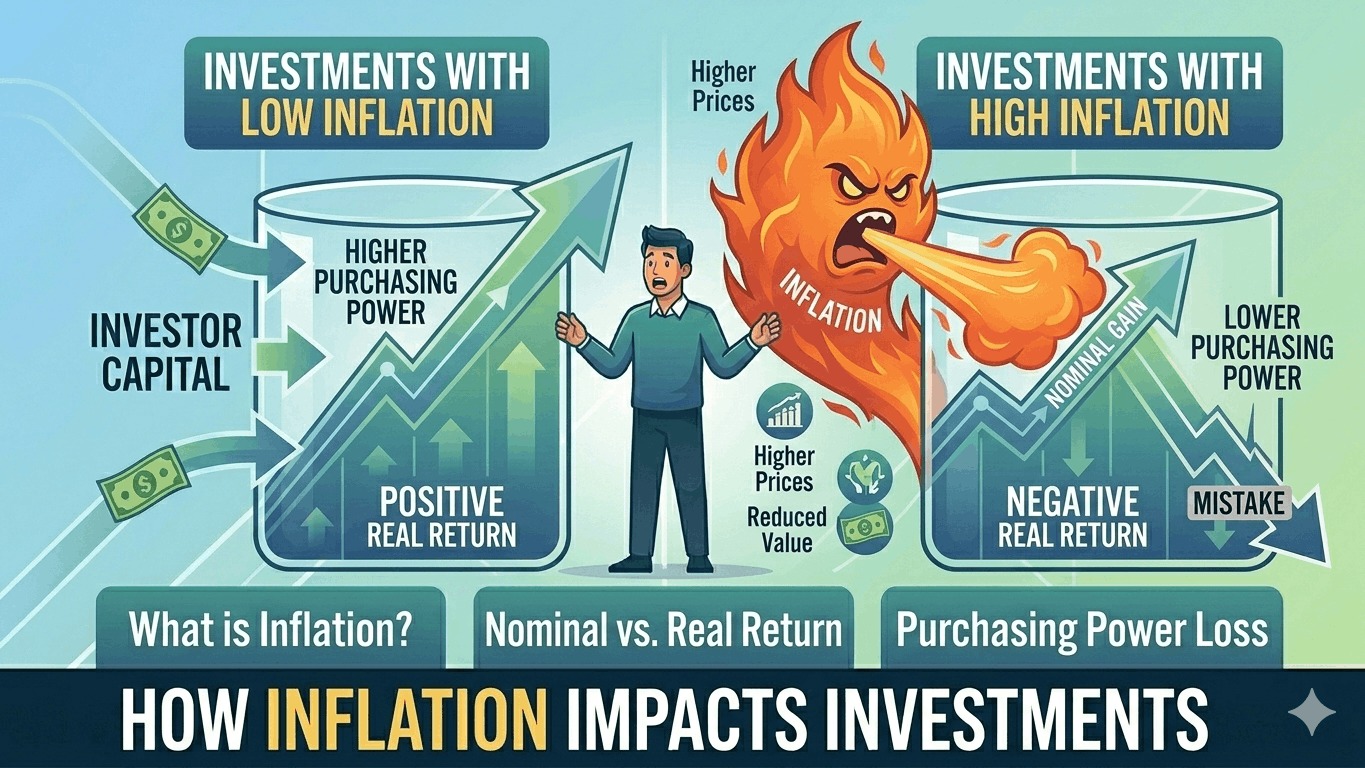
At its core, inflation reduces purchasing power. When prices rise over time, each dollar buys less than it used to. That means an investment is not truly growing in a meaningful way unless it outpaces inflation. A portfolio may appear to be increasing in value, but if inflation is rising quickly, the real return may be much smaller than it looks on paper.
For investors in the United States, understanding how inflation impacts investments is essential. It can influence stocks, bonds, cash savings, real estate, retirement accounts, and even the types of strategies investors prefer during certain economic periods. Whether inflation is low, moderate, or high, it shapes the environment in which investments grow or struggle.
This article explains how inflation affects different types of investments, why it matters for long-term planning, and how investors can think about protecting their portfolios from inflation over time.
What Is Inflation?
Inflation is the rate at which the general price of goods and services rises over time. As inflation increases, the purchasing power of money declines.
For example, if something costs $100 today and inflation pushes the price to $105 next year, the same amount of money buys less than before. In simple terms, inflation makes money worth less over time unless your income or investment returns keep up.
Inflation is a normal part of the economy, but the pace matters. Low and steady inflation is usually easier for households and investors to manage. High inflation can create more financial pressure and uncertainty.
Why Inflation Matters for Investors
Inflation matters because investing is not only about making money in dollar terms. It is also about preserving and increasing real purchasing power.
Imagine your investment portfolio earns a 6% return in one year. That sounds positive. But if inflation is 4% during that same period, your real gain is much smaller than the number suggests. If inflation were even higher, the investment might barely be keeping up.
This is why investors often think in terms of real returns, not just nominal returns.
- Nominal return is the return your investment shows before inflation.
- Real return is the return after inflation is taken into account.
This difference is especially important for long-term goals such as retirement, education savings, and wealth building.
Inflation and Purchasing Power
The biggest direct effect of inflation is the gradual loss of purchasing power.
If your money is sitting in cash and inflation rises faster than your savings grow, the real value of that cash declines. Even though the dollar amount stays the same, what it can buy becomes smaller over time.
This is one reason many people invest instead of keeping all their money in savings. Investing offers the potential to grow money faster than inflation over the long term.
Here is a simple example:
| Year | Savings Balance | Inflation Effect | Real Buying Power |
|---|---|---|---|
| Start | $10,000 | None | $10,000 |
| After 1 year | $10,000 | Prices rise 5% | About $9,524 in prior-year buying power |
| After 2 years | $10,000 | Prices keep rising | Even lower real value |
This example shows that cash may feel safe in nominal terms, but inflation can quietly reduce its value.
How Inflation Impacts Stocks
Stocks are often seen as one of the better long-term defenses against inflation, but the relationship is not always simple.
Over long periods, stocks can help investors outpace inflation because many companies can grow earnings, raise prices, and expand over time. Businesses that maintain pricing power may be able to pass some higher costs on to customers, which helps protect profits.
However, inflation can affect stocks differently depending on the economic environment.
When inflation is moderate
Moderate inflation is often manageable for many businesses. Companies may continue growing, consumers may still spend, and the stock market may continue functioning normally.
When inflation is high
High inflation can hurt stocks in several ways:
- Rising costs can reduce profit margins
- Consumer spending may weaken
- Interest rates may rise
- Valuations may fall as borrowing becomes more expensive
- Market uncertainty may increase
Some sectors handle inflation better than others. For example, companies with strong pricing power may perform better than businesses with thin margins or heavy debt.
How Inflation Impacts Cash and Savings
Cash feels safe because its face value does not fluctuate like stocks or bonds. But inflation can make cash one of the weakest long-term holdings if it is not earning enough interest.
For example, if your savings account earns 2% interest while inflation is 5%, your money is losing real value even though the balance is growing slightly.
This does not mean cash has no role in a portfolio. Cash is still useful for:
- Emergency funds
- Short-term expenses
- Stability
- Liquidity
But for long-term wealth building, holding too much in low-yield cash during inflationary periods can be costly.
How Inflation Impacts Real Estate
Real estate is often discussed as a possible inflation hedge, though the effect is not the same in every situation.
Property values and rents may rise over time, which can help real estate keep pace with inflation in some environments. Rental income may also increase if landlords can raise rents.
That said, inflation can also bring challenges:
- Higher interest rates can make mortgages more expensive
- Property maintenance costs may rise
- Insurance and taxes can increase
- Affordability may fall for buyers
So while real estate can sometimes benefit from inflation, it is not automatically protected in every inflationary period.
How Inflation Impacts Retirement Planning
Inflation is especially important in retirement planning because retirement goals often stretch over decades.
A retirement portfolio is not just meant to grow. It also needs to support future living expenses that may be much higher than today’s costs.
For example, a person who thinks they need $50,000 per year in retirement today may need significantly more by the time they actually retire if inflation continues over many years.
This is why retirement investors often focus on:
- Long-term growth assets
- Diversification
- Real return potential
- Periodic portfolio reviews
- Inflation-aware withdrawal planning
Inflation can also affect retirees more directly because they may rely on portfolio withdrawals for income. If living costs rise faster than expected, withdrawals may need to increase, which can put additional strain on savings.
Inflation and Investment Strategy
Inflation can influence how investors think about portfolio strategy.
During low inflation periods, investors may be more comfortable with traditional stock-bond allocations and long-duration assets. During high inflation periods, investors may become more focused on preserving purchasing power and adjusting portfolio risk.
This can lead to changes such as:
- Reducing excessive cash holdings
- Reviewing bond duration
- Increasing attention to real returns
- Focusing on pricing power in stocks
- Reassessing retirement assumptions
- Adding inflation-sensitive assets where appropriate
The right response depends on the investor’s goals and time horizon. A long-term investor may not need major changes, but they should understand how inflation can affect outcomes.
Example of Real Return
Here is a simple illustration of why inflation matters.
| Investment Return | Inflation Rate | Approximate Real Return |
|---|---|---|
| 8% | 2% | 6% |
| 8% | 5% | 3% |
| 5% | 5% | 0% |
| 3% | 6% | -3% |
This table shows that the same investment return can feel very different depending on inflation.
A 5% return may look solid in a low-inflation world, but it may not provide any real growth if inflation is also 5%.
Common Mistakes Investors Make During Inflation
Inflation often leads to emotional or reactive decision-making. Some common mistakes include:
Holding too much cash for too long
Cash has a purpose, but too much idle cash can lose real value during inflation.
Chasing whatever seems inflation-proof
There is no guaranteed inflation-proof investment. Investors sometimes rush into trendy assets without understanding the risks.
Ignoring diversification
Inflation can affect different assets differently, but abandoning diversification can increase overall risk.
Focusing only on nominal returns
A portfolio may look like it is growing, but real return is what matters for long-term financial progress.
Making sudden portfolio changes based on headlines
Inflation can be highly discussed in the media, but long-term investors usually benefit more from thoughtful strategy than reactive moves.
How Investors Can Respond to Inflation
The best response to inflation is usually not panic. It is planning.
Investors can think about inflation by:
- Staying focused on real purchasing power
- Reviewing long-term goals regularly
- Keeping a diversified portfolio
- Avoiding excessive low-yield cash for long-term money
- Considering inflation-aware assets when appropriate
- Making sure the portfolio still matches risk tolerance and time horizon
For many investors, the goal is not to eliminate inflation risk entirely. It is to build a portfolio that has a reasonable chance of outpacing inflation over the long term.
Final Thoughts
Inflation impacts investments by reducing purchasing power, changing real returns, influencing interest rates, and affecting how different asset classes perform. It can quietly erode the value of cash, pressure fixed-income investments, reshape stock market conditions, and alter retirement planning assumptions.
For investors in the United States, inflation is not just an economic headline. It is a real force that affects long-term financial outcomes. A portfolio that ignores inflation may appear stable on the surface while losing value in real terms over time.
The key is to understand that inflation is part of investing, not a temporary side issue. By focusing on real returns, diversification, and long-term planning, investors can make smarter decisions about how to protect and grow wealth in an environment where prices do not stand still.