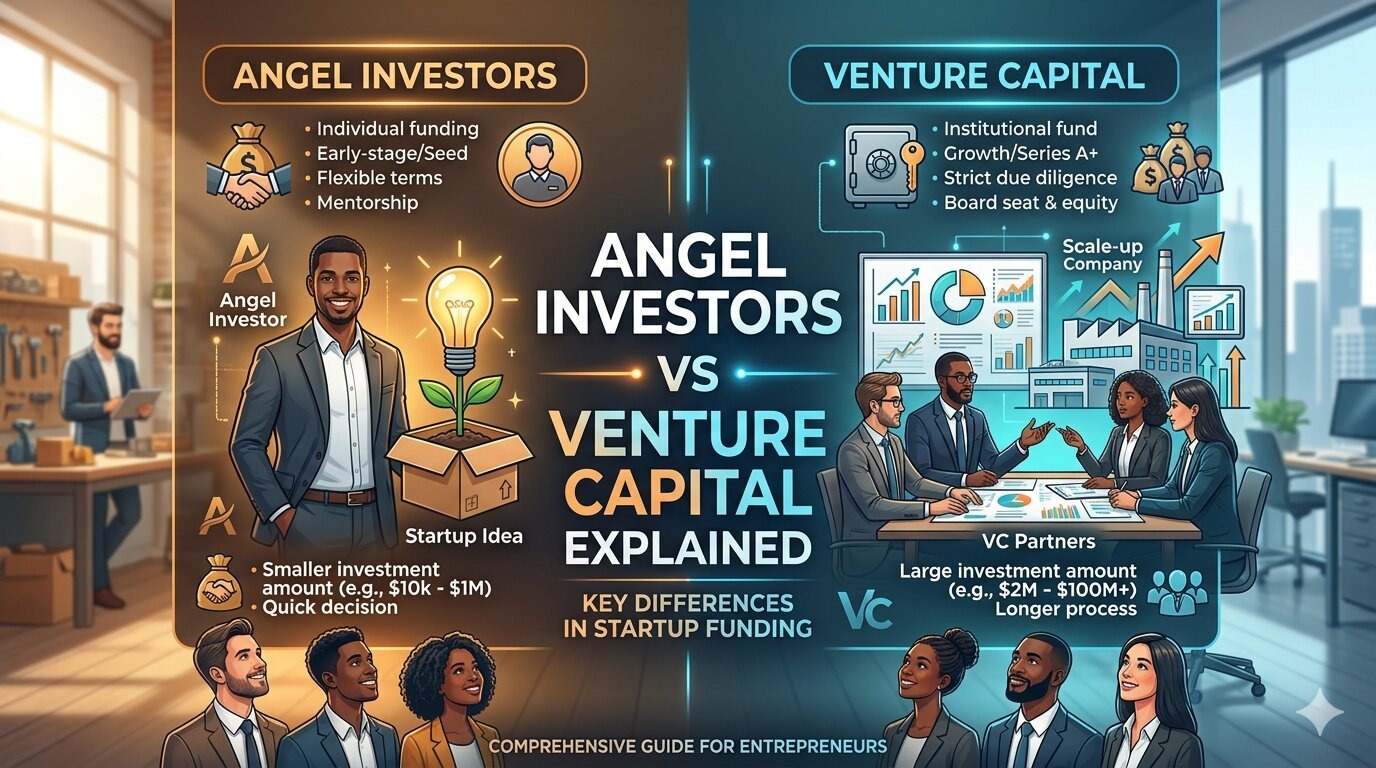
If you’re planning to raise money for your startup, you’ll almost certainly come across two common options: angel investors and venture capital (VC).
At first glance, they might seem similar—both provide funding in exchange for equity. But in reality, they operate very differently, and choosing the wrong one can affect your business more than you might expect.
Let’s break it down in a clear, practical way so you can decide what actually fits your situation.
What Are Angel Investors?
Angel investors are individuals who invest their personal money into startups, usually at an early stage.
They’re often:
- Successful entrepreneurs
- Business professionals
- High-net-worth individuals
But more importantly, they tend to invest not just in ideas—but in people.
They look at:
- Your vision
- Your commitment
- Your potential
What Is Venture Capital?
Venture capital comes from firms that manage pooled funds from multiple investors.
These firms invest in startups with high growth potential, typically at a later stage than angel investors.
They’re more structured and data-driven, focusing on:
- Scalability
- Market size
- Revenue potential
In simple terms:
- Angels invest personally
- VCs invest professionally
Key Differences at a Glance
Here’s a simple comparison to understand the core differences:
| Factor | Angel Investors | Venture Capital |
|---|---|---|
| Source of Funds | Personal money | Investment firms |
| Investment Stage | Early-stage | Growth stage |
| Investment Size | Smaller ($10K–$500K) | Larger ($1M+) |
| Decision Speed | Faster | Slower |
| Involvement | Mentorship-focused | Strategy & control-focused |
This table gives you a quick overview, but the real differences go deeper.
When Should You Choose an Angel Investor?
Angel investors are ideal when:
- You’re in the early stages
- You’re still validating or refining your product
- You need smaller funding amounts
- You value mentorship and guidance
Real-World Example
A founder with a new SaaS idea builds a basic product but needs funding to improve it.
An angel investor steps in:
- Provides $50,000
- Offers guidance based on experience
- Helps connect with early customers
At this stage, flexibility matters more than scale.
When Should You Choose Venture Capital?
Venture capital is more suitable when:
- Your business is already growing
- You have proven traction
- You need large-scale funding
- You’re ready to scale aggressively
Real-World Example
A startup with strong user growth wants to expand globally.
A VC firm invests:
- $2 million funding
- Strategic direction
- Access to networks and partnerships
But they also expect fast growth and strong returns.
Pros and Cons (Honest Comparison)
Angel Investors
Pros:
- Easier access (relatively)
- Faster decisions
- Flexible terms
- Personal mentorship
Cons:
- Limited funding
- Less structured support
- Depends heavily on the individual
Venture Capital
Pros:
- Large funding amounts
- Strong networks
- Strategic guidance
- Credibility boost
Cons:
- Loss of control
- High growth pressure
- Complex agreements
Ownership and Control (Important!)
This is where things get serious.
Both angels and VCs take equity—but the impact is different.
- Angel investors usually take smaller stakes
- VC firms often take larger stakes and board control
This means:
- More funding = less ownership
- Less ownership = less control
It’s a trade-off you need to think about carefully.
How to Decide What’s Right for You
Ask yourself these questions:
- What stage is my business in?
- How much money do I actually need?
- Am I ready to scale aggressively?
- How much control am I willing to give up?
There’s no universal answer—only what fits your situation.
How This Connects to Your Funding Strategy
Angel and VC funding are just part of a bigger funding journey.
Typically:
- Early stage → Bootstrapping + Angel investors
- Growth stage → Venture capital
If you want a complete overview, read:
How to Raise Capital for Your Startup
https://statush.com/business/how-to-raise-capital-for-your-startup
Common Mistakes to Avoid
1. Choosing Based Only on Money
The right investor matters more than the amount.
2. Giving Away Too Much Equity Too Early
This can hurt you in later funding rounds.
3. Ignoring Long-Term Impact
Investors stay with you for years—not months.
4. Not Doing Background Checks
Always research your investors.
Practical Tips
- Build relationships before you need funding
- Be clear about your goals
- Prepare a strong pitch
- Understand the terms before signing
- Think long-term, not just short-term cash
One honest insight: the best investors don’t just give money—they make your journey easier.
Alternative Option: Funding Without Equity
If you’re not comfortable giving up ownership, you can explore:
How to Get Funding Without Giving Equity
https://statush.com/business/how-to-get-funding-without-giving-equity
This approach works well for certain types of businesses.
Final Thoughts
Angel investors and venture capital are both powerful tools—but they serve different purposes.
Angel investors help you start.
Venture capital helps you scale.
Choosing between them isn’t about which is better—it’s about what your business actually needs right now.
Take your time, understand the trade-offs, and choose wisely.
Because the people you bring into your business can shape its future just as much as your idea does.