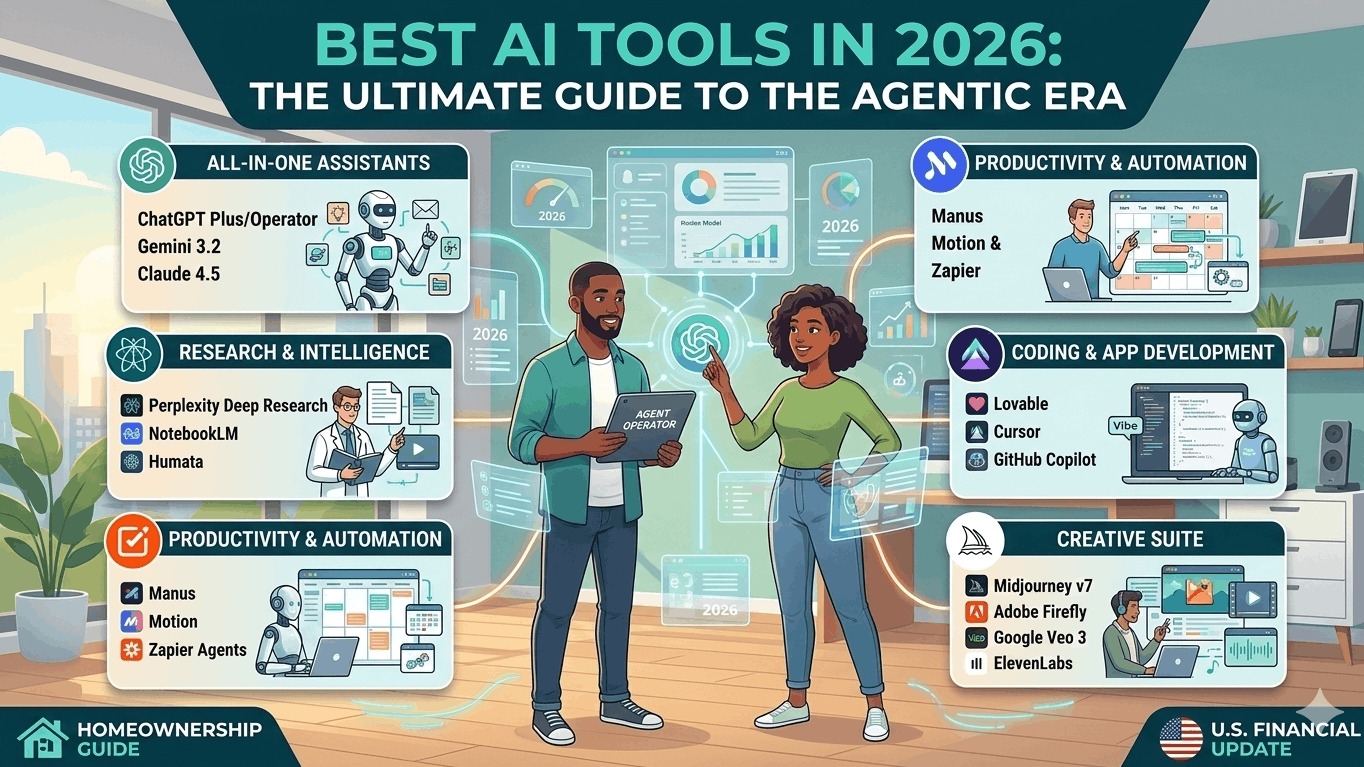
In 2026, we have moved past the era of "chatbots" and entered the age of Agentic AI. AI is no longer just an instrument you "talk" to; it has become a digital colleague that executes multi-step workflows, manages complex projects, and bridges the gap between digital intent and physical action.
This year, the standout tools aren't just the ones with the most parameters, but the ones that offer the highest "agency"—the ability to complete tasks with minimal hand-holding. Here are the best AI tools of 2026 across every major category.
1. All-In-One AI Assistants (The "Digital Co-pilots")
These platforms serve as the central hub for your work and personal life, capable of reasoning across text, code, and multimedia.
- ChatGPT (Plus/Pro): Still the "Gold Standard" for versatility. In 2026, ChatGPT features the Operator system, allowing it to navigate your web browser to perform tasks like booking travel or managing your cloud files autonomously.
- Gemini 3.2 (Ultra): Google’s flagship model excels in its 2-million-token context window. This makes it the best choice for researchers who need to analyze thousands of documents or hours of video footage in a single prompt.
- Claude 4.5: Anthropic’s model remains the favorite for creative writers and developers. Its "Artifacts" feature has evolved into a full real-time collaborative workspace where you can build and preview apps or documents side-by-side with the AI.
2. Research & Intelligence Tools
In a world of information overload, these tools act as your personal intelligence agency, synthesizing data with high accuracy.
- Perplexity (Deep Research): This is the ultimate "search killer." Its Deep Research mode performs dozens of searches simultaneously, consults nearly 50 sources, and produces a 1,500-word cited report in under three minutes.
- NotebookLM: Google’s specialized research assistant. You can upload a "source of truth" (PDFs, transcripts, or notes), and it creates a personalized AI that only answers based on your data. Its Audio Overviews can turn your dense reports into a two-person podcast conversation for easy listening.
- Humata: The best tool for technical professionals (lawyers, scientists, engineers). It specializes in long-document analysis, providing clickable citations that jump you directly to the exact paragraph where a data claim was found.
3. Productivity & Workflow Automation
2026 is the year that "Zapier-style" automation became invisible. These tools manage your time and tasks without you asking.
- Manus: A pioneer in the "Agentic" space. Unlike assistants that tell you how to do something, Manus simply does it. It can research a market, draft a proposal, and set up a landing page entirely in the background.
- Motion: The AI calendar that has effectively replaced human assistants for many. It automatically reshuffles your schedule based on priority changes, ensuring your "Deep Work" blocks are protected even when meetings are added.
- Zapier Agents: These are self-directed AI teammates that can take multi-step actions across your entire tech stack (Slack, HubSpot, Notion) autonomously.
4. Coding & App Development (The "Vibe-Coding" Revolution)
The barrier between having an idea and building an app has virtually disappeared.
- Lovable: The leader in the "vibe-coding" movement. You describe a web app in plain English, and Lovable builds the frontend, configures the backend database, and deploys it live. It can even debug its own code in real-time.
- Cursor: The essential IDE (Integrated Development Environment) for 2026. It doesn't just suggest code; it understands your entire repository, allowing you to refactor massive codebases with a single sentence.
- GitHub Copilot Workspace: A "plan-first" environment where the AI drafts a technical specification, breaks it into tasks, and executes the code changes across multiple files.
5. Creative Suite: Image, Video, and Audio
AI media has reached "production-grade" in 2026, moving from glitchy clips to cinematic consistency.
Image & Design
- Midjourney v7: Still the king of aesthetic quality. Its 2026 models feature perfect text rendering and "Stealth Mode" for private commercial work.
- Adobe Firefly (Creative Cloud): The safest bet for corporate use. It is trained on IP-cleared data and integrates natively into Photoshop and Illustrator for "Generative Fill" workflows.
Video & Audio
- Google Veo 3: Capable of generating high-fidelity, minute-long cinematic clips with consistent lighting and physics. It is a favorite for social media teasers and high-impact ads.
- Runway Gen-4: Features advanced "Camera Control" and "Director Mode," allowing creators to move a virtual camera through a generated scene with professional precision.
- ElevenLabs: The industry standard for voice. In 2026, its voice cloning is indistinguishable from reality, supporting over 30 languages with emotional nuances like whispering or shouting.