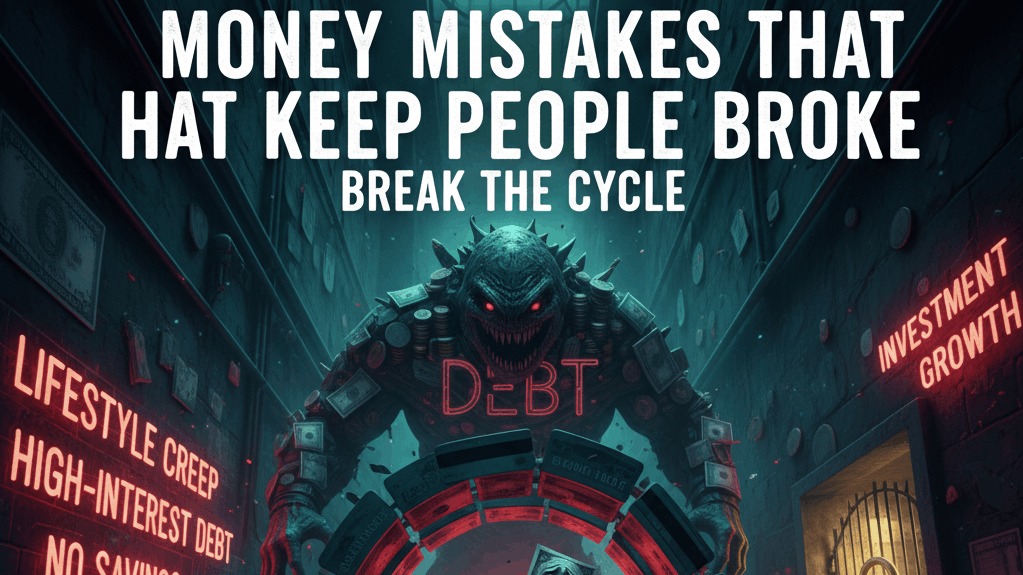
Being "broke" is rarely about how much money you make; it’s usually about where that money goes. Small, repetitive habits and psychological traps can drain even a high salary, leaving you feeling like you’re running on a financial treadmill.
By identifying these common mistakes, you can stop the leaks and start building real wealth.
1. Falling for "Lifestyle Creep"
Lifestyle inflation occurs when your spending rises as quickly as your income. If you get a 10% raise and immediately buy a more expensive car or move into a pricier apartment, your net worth stays exactly the same.
- The Trap: Thinking "I deserve this" every time you see a bump in pay.
- The Fix: Live on your previous salary for at least six months after a raise. Divert the difference into savings or investments before you ever "see" it.
2. Ignoring the Power of Compound Interest
Many people wait until they "have enough money" to start investing. Unfortunately, the most valuable asset in investing isn't cash—it's time.
- The Trap: Delaying retirement contributions because you’re in your 20s or 30s.
- The Fix: Start now, even if it’s only $20 a month. The mathematical advantage of starting early is nearly impossible to make up for later in life.
3. High-Interest Consumer Debt
Carrying a balance on a credit card is a financial emergency. With average interest rates often exceeding 20%, you are essentially paying a "stupidity tax" on items that are likely already losing value.
- The Trap: Using credit cards to fund a lifestyle you can't afford in cash.
- The Fix: Use the Debt Snowball (paying smallest balances first for momentum) or the Debt Avalanche (paying highest interest first to save money).
4. Being "Penny Wise and Pound Foolish"
People often spend hours trying to save $0.50 on a gallon of milk but ignore the $500 they could save by refinancing a high-interest mortgage or shopping for better insurance rates.
- The Trap: Obsessing over small, daily expenses while ignoring "Big Win" expenses.
- The Fix: Focus on the "Big Three": Housing, Transportation, and Food. Optimizing these three categories will have a 100x greater impact than skipping a latte.
5. Lack of a Financial "Buffer"
Without an emergency fund, every minor inconvenience (a flat tire, a broken tooth) becomes a high-interest debt event. This keeps people in a cycle of borrowing and paying back, never allowing them to get ahead.
- The Trap: Relying on credit cards as an "emergency plan."
- The Fix: Build a starter emergency fund of $1,000 immediately. This acts as a shield between you and your debt.
Here are 10 bold and thought-provoking quotes for “Money Mistakes That Keep People Broke”
- “It’s not how much you make — it’s the mistakes you repeat that keep you broke.”
- “Ignoring your finances today creates financial stress tomorrow.”
- “Lifestyle upgrades without income upgrades lead to silent debt.”
- “Spending to impress others is the fastest way to depress your bank account.”
- “Broke isn’t always about income — sometimes it’s about habits.”
- “If you don’t control your money, your money will control you.”
- “Debt feels small monthly but heavy long term.”
- “Avoiding a budget doesn’t avoid the problem — it delays it.”
- “Wealth grows quietly. Broke habits are loud and flashy.”
- “Financial freedom begins when excuses end.”