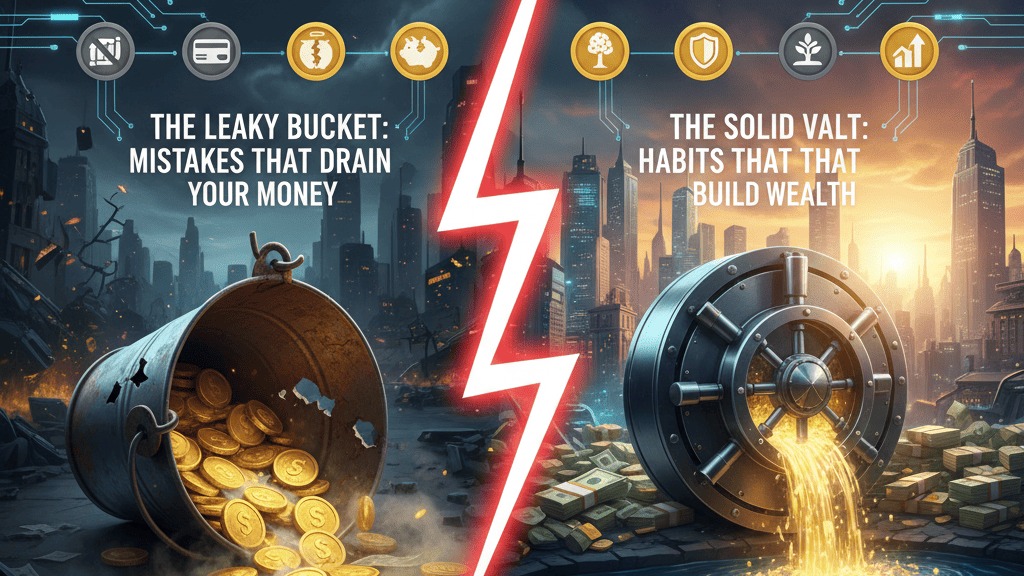
Even with a high income and the best intentions, many people find themselves "treading water" financially. In 2026, the economy moves faster, and the traps are more subtle. Building wealth isn't just about doing the right things; it’s about identifying and eliminating the "silent killers" of capital.
If your net worth isn't growing despite your hard work, you might be falling for one of these common pitfalls.
The Silent Wealth Killers
- Lifestyle Creep (The "Upgrade" Trap): This is the #1 reason high earners stay broke. As your salary increases, so does your spending. A $10,000 raise often turns into a $10,000 more expensive car or apartment.
- Emotional Investing (Panic & Greed): 2025 showed us that investors who panic-sell during a dip lock in their losses, while those who stay the course recover.
- The Subscription "Vampire" Effect: In 2026, the average household loses over $2,000 annually to forgotten digital subscriptions. Small monthly leaks drain the reservoir.
- High-Interest "Micro-Loans" (BNPL): "Buy Now, Pay Later" schemes have become a massive debt trap, encouraging people to spend 30% more on average by hiding the true cost of items.
Structural Failures
- Not Having an Emergency Fund: Without 3–6 months of cash, one car repair or medical bill can force you to sell your long-term investments at the worst possible time.
- Keeping Too Much Cash: While an emergency fund is vital, keeping excess cash in a low-interest account is a mistake. Inflation quietly eats your purchasing power.
- Overlooking Fees: A 1% difference in investment fees can cost you hundreds of thousands of dollars over 30 years. In 2026, high-fee traditional funds are often outperformed by low-cost direct index options.
The "Safety" Fallacy: Holding Too Much Cash
In volatile times, cash feels like a warm blanket. However, in 2026, with global inflation fluctuating and currency values shifting, "sitting on the sidelines" is a guaranteed way to lose purchasing power.
- The Mistake: Keeping $100,000 in a standard savings account earning 0.5% while inflation sits at 3%.
- The Reality: You are effectively losing $2,500 in purchasing power every year.
- The Fix: Calculate your "True Emergency Fund" (6 months of expenses) and invest every dollar above that into productive assets.
Underestimating "Tax Drag"
Most people focus on their "Gross Return" (what the stock market did), but the only number that matters is your Net After-Tax Return.
- The Mistake: Trading frequently in a standard brokerage account, triggering short-term capital gains taxes (which can be as high as 37% depending on your bracket).
- The Reality: High turnover in your portfolio is like driving with the emergency brake on.
- The Fix: Prioritize tax-advantaged accounts (401ks, IRAs, HSAs) and hold assets for longer than a year to qualify for long-term capital gains rates.
The "Expert" Trap: Chasing Alpha
Many investors believe they can beat the market by following "finfluencers" or buying into complex, actively managed funds.
- The Mistake: Paying a 1.5% management fee to a fund manager who consistently underperforms the S&P 500.
- The Reality: Over a 20-year period, roughly 90% of active managers fail to beat a simple, low-cost index fund.
- The Fix: Embrace "Average." By buying the entire market through an index fund, you are mathematically likely to outperform the majority of professional investors.
Ignoring the "Cost of Convenience"
In 2026, the economy is built on frictionless spending. Apps make it too easy to spend $15 here and $20 there without "feeling" the loss.
- The Mistake: Relying on food delivery, premium ride-shares, and "VIP" upgrades for daily tasks.
- The Reality: These "convenience taxes" can easily total $1,000 a month. If that $1,000 were invested at a 7% return, it would grow to nearly $500,000 over 20 years.
- The Fix: Apply a "24-Hour Rule" for any non-essential purchase over $50.
Lack of "Wealth Protection" (Insurance & Estate Planning)
Building a skyscraper without a foundation is a recipe for collapse. Many people build wealth but fail to shield it.
- The Mistake: Having a million-dollar portfolio but no disability insurance or an outdated Will.
- The Reality: One lawsuit or one health crisis can liquidate your life's work if you aren't properly insured.
- The Fix: Ensure you have adequate Umbrella Insurance and a basic estate plan to protect your assets from legal and probate costs.